Journeying vs Meditation: Understanding the Difference
Journeying vs. Meditation: What’s the Difference?
Many people exploring spiritual practices eventually encounter two common methods of inner exploration: meditation and shamanic journeying.
Both practices involve entering a quieter state of awareness and turning attention inward. Because of this, they are sometimes assumed to be the same thing. However, while meditation and shamanic journeying share some similarities, they are actually quite different in purpose, method, and experience.
Understanding the difference between meditation and shamanic journeying can help individuals choose the practices that best support their personal growth, spiritual development, and emotional healing.
What Is Meditation?
Meditation is a practice that has existed for thousands of years across many spiritual and philosophical traditions. While the specific methods vary, the core purpose of meditation is generally to cultivate stillness, awareness, and presence.
In many meditation practices, the goal is to quiet the mind and observe thoughts without becoming attached to them. By focusing on the breath, repeating a mantra, or simply observing the flow of thoughts, individuals gradually develop a calmer and more centered state of awareness.
Meditation is widely known for its many benefits, including:
reducing stress and anxiety
improving focus and emotional balance
increasing mindfulness and self-awareness
promoting a sense of inner peace
For many people, meditation becomes an important daily practice for maintaining mental clarity and emotional stability.
What Is Shamanic Journeying?
Shamanic journeying is a practice rooted in ancient shamanic traditions that have existed in cultures around the world for thousands of years. Unlike meditation, which often focuses on stillness and observation, shamanic journeying involves actively entering an altered state of consciousness in order to explore symbolic or spiritual realms of awareness.
Traditionally, shamans entered these states of awareness through rhythmic drumming, chanting, or other ceremonial practices. The rhythmic sound helps shift the brain into a deeply focused state that allows the practitioner to access intuitive or symbolic guidance.
During a shamanic journey, individuals may encounter powerful imagery, archetypal symbols, or guiding forces that provide insight related to a question, emotional challenge, or life situation.
Rather than simply observing the mind, shamanic journeying invites active participation within the experience.
Journeying vs. Meditation: The Key Differences
Although both practices involve altered states of awareness, the intention behind each practice is quite different.
Meditation is often about quieting the mind and observing thoughts without engaging them. The goal is usually to develop presence and awareness in the moment.
Shamanic journeying, on the other hand, is a form of guided inner exploration. Instead of remaining passive, the practitioner interacts with symbolic imagery and intuitive impressions that arise during the journey.
Some of the key differences include:
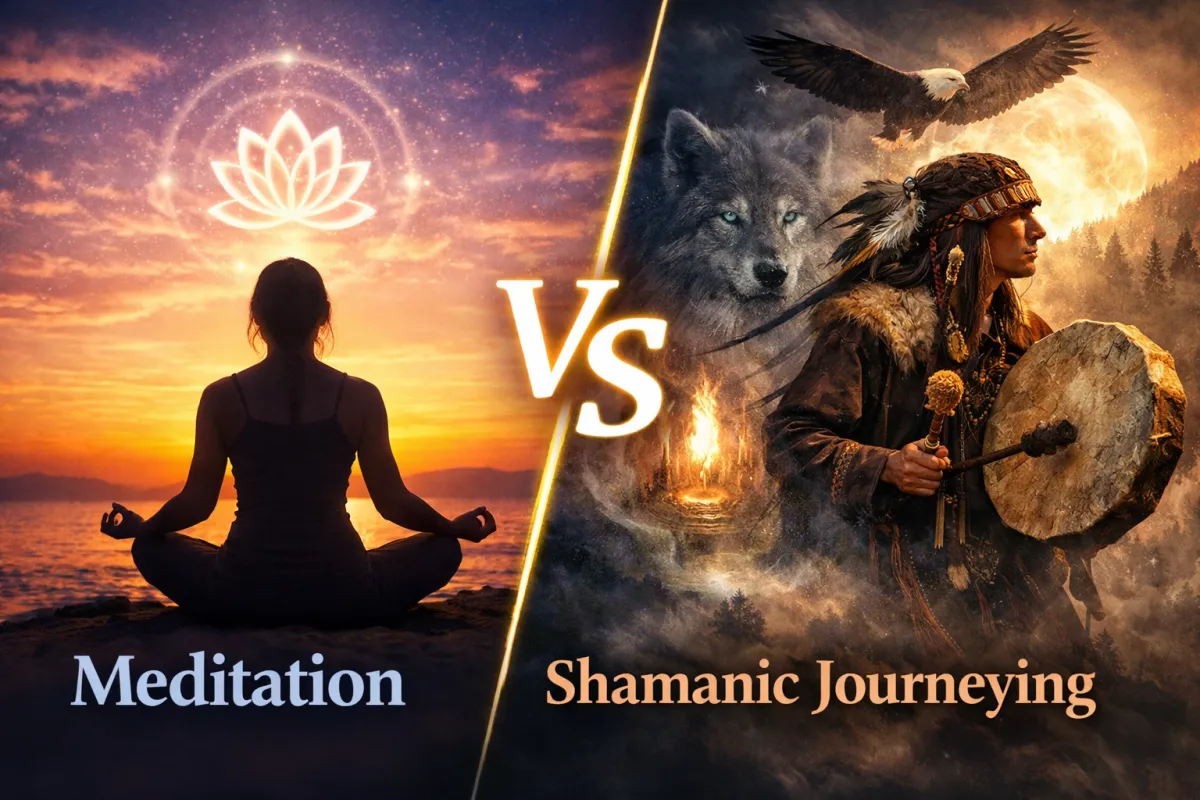
Meditation
focuses on stillness and observation
quiets the thinking mind
cultivates mindfulness and presence
emphasizes non-attachment to thoughts
Shamanic Journeying
involves active inner exploration
works with symbolic imagery and intuition
seeks guidance or healing insight
often includes rhythmic drumming or guided facilitation
Both practices can be powerful tools for personal growth, but they serve different purposes.
The Healing Benefits of Shamanic Journeying
Many people are drawn to shamanic journeying because it allows them to explore deeper layers of the subconscious and intuitive mind.
In shamanic traditions, journeying is often used as a method for gaining clarity, emotional healing, and spiritual guidance. The imagery and insights that arise during a journey can reveal patterns or beliefs that may not be visible in everyday awareness.
Some of the benefits people report from practicing shamanic journeying include:
gaining clarity about life direction
releasing emotional or energetic blocks
strengthening intuitive awareness
deepening connection to inner guidance
exploring personal symbolism and archetypal imagery
Because the experience is often symbolic and intuitive rather than analytical, many individuals discover insights that feel both deeply personal and surprisingly clear.
Why Many Spiritual Traditions Use Journeying
In many indigenous traditions, journeying was used by trained shamans to receive information that could help restore balance for individuals or communities.
These practices were not seen as mystical or unusual within their cultures. Instead, they were recognized as practical tools for understanding the deeper forces influencing life.
Today, modern spiritual practitioners often explore journeying as a way of reconnecting with these ancient methods of inner exploration.
When practiced respectfully and with proper guidance, shamanic journeying can offer a structured framework for developing intuition, exploring the subconscious mind, and supporting emotional healing.
Choosing the Practice That Supports Your Path
For many people, meditation and shamanic journeying are not competing practices but complementary ones.
Meditation can help cultivate the calm awareness needed to quiet the mind, while journeying offers a way to explore deeper intuitive insights and symbolic understanding.
Together, these practices can create a powerful foundation for personal growth and spiritual awareness.
Individuals who feel drawn to explore journeying more deeply often find that learning traditional frameworks—such as working with the medicine wheel, ceremony, and guided journey techniques—provides greater clarity and structure as they develop their practice.
These traditions offer time-tested methods for exploring spiritual awareness while remaining grounded in respect, balance, and personal responsibility.
A Path of Inner Exploration
At its heart, both meditation and shamanic journeying invite individuals to explore the inner landscape of their own consciousness.
Meditation teaches stillness and presence. Journeying invites exploration and discovery.
For those walking a path of spiritual growth or personal transformation, these practices can open the door to deeper awareness, greater intuition, and a stronger connection with the unseen dimensions of life.
Many people find that once they begin exploring these practices, they develop a renewed sense of curiosity about the ancient traditions that have guided seekers for generations.
And for some, that curiosity becomes the beginning of a much deeper journey into understanding themselves, their purpose, and the interconnected nature of life itself.
For those who feel a deeper calling toward shamanic practice and healing traditions, you can learn more about the practitioner path here:
Learn more about the path of becoming a shamanic practitioner